September’s been another challenging month for observing—clear skies by day, but persistently cloudy nights. Work has been hectic too, with Q4 planning in the works, so I’ve had only a few nights to look up. What’s exciting is seeing new constellations firsthand. I only started this hobby in March this year, and while I knew theoretically from books that constellations change each month and season, actually observing them is far more exciting than I anticipated (in Tagalog, Kilig)!
M31, M33 and NGC 7293 at Lalashan 拉拉山星樂園
- Bortle: 4
- Event: 探索北橫夜間之美「拉拉山星樂園」開幕
- Location: 巴陵鐵塔
I’m happy to say I’ve influenced some friends to take up stargazing. I’ve received a couple of inquiries about the Seestar S30, my smart telescope, and a colleague asked if he could borrow mine for a stargazing trip with his wife. Of course I agreed! I offered to teach him how to use it and also asked him to collect data for me. I suggested these would be show-off targets that would amaze their group, so I asked him to target M31 (Andromeda Galaxy), M33 (Triangulum Galaxy), and NGC 7293 (the Helix Nebula, sometimes called the “Eye of Sauron”).
I couldn’t find information about this stargazing event despite multiple Google searches, even in Chinese, so I may have been searching incorrectly. My teammate said his wife found it, so perhaps it wasn’t a “me” problem. They even invited me, but I thought they deserved time together under the stars, so I stayed up providing live support when he had questions instead.
Here’s a side-by-side comparison of the Andromeda Galaxy captured under Bortle 4 (left) versus Bortle 7 (right) skies with 20-min exposures at 20s subs:
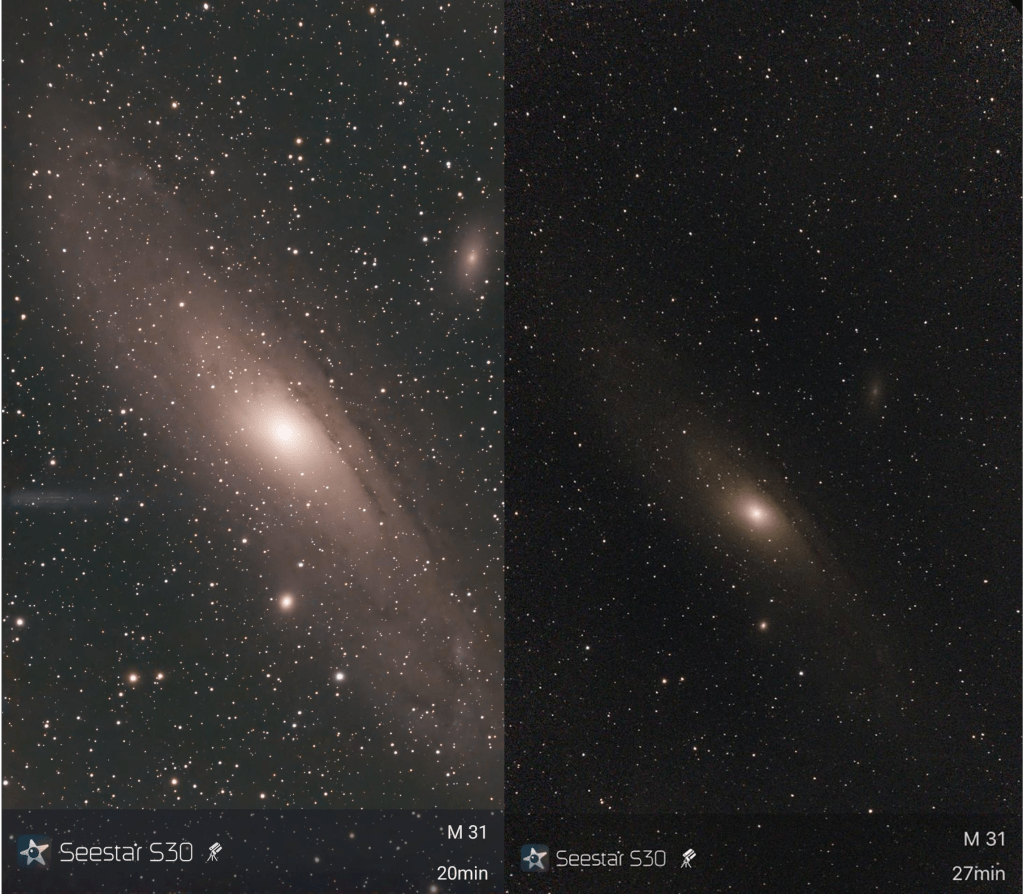
I was finally getting excited because, even though M33 and M31 are easy targets from my location, light pollution from Taipei combined with high cloud cover means I usually capture only faint wisps—which can be quite demotivating.
I combined the data he collected with mine, processed it using Siril and Graxpert to stretch the data. You can see the results in my Instagram post—the first three photos.
Back in Xindian, my spirits renewed, I called Gerald and we decided to explore other constellations. We’ve developed a new search workflow and learned factors to determine what objects to observe.
What to look up tonight?
- Use Stellarium or your favorite star map application
- Select a constellation to explore
- Google: “[constellation] list of DSOs” (e.g., “Cetus constellation list of DSOs”)
- You’ll likely see an AI Overview (if available) for quick results and discover helpful resources such as:
- Select an object with low magnitude and large apparent size.
Using this approach, Gerald and I successfully located targets in the Sculptor and Cetus constellations!
Sculptor and Cetus Constellation
Due to light pollution from Taipei, we must observe targets on the opposite side of the sky. My location presents several limitations—houses and mountains block the horizon, restricting which targets I can pursue.
New DSOs!
- NGC 253, Sculptor Galaxy
- NGC 55, String of Pearls Galaxy
- M77, Squid Galaxy + NGC 1055 (very small targets)
- NGC 246, a planetary nebula
Here’s a star trail captured by GoPro where the Sculptor and Cetus constellations are visible. You can also see the limitations I mentioned.
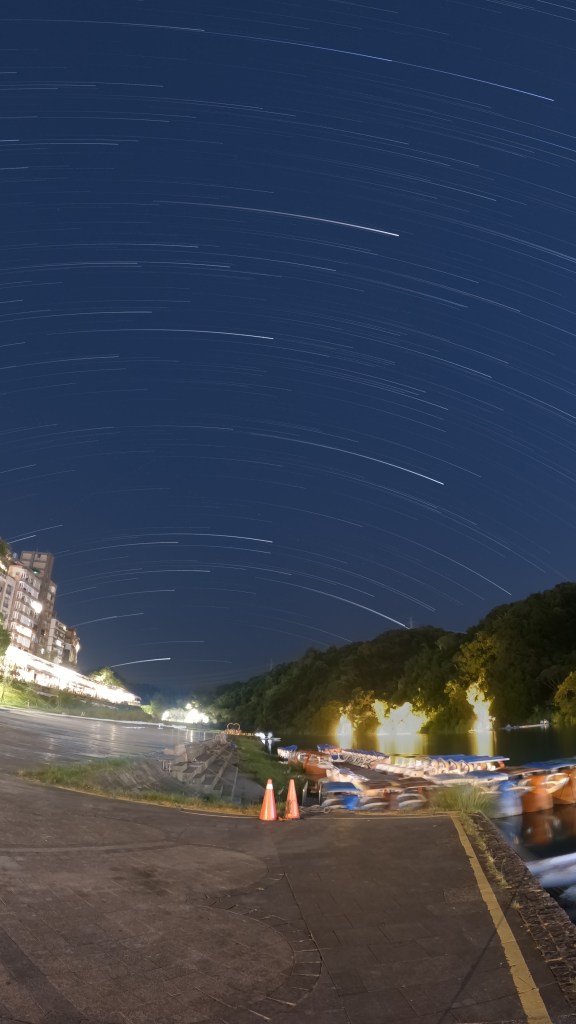
Bitan Riverside, Sep-29, 2025
===
That’s it for now! Stay tuned for posts on the Harvest Moon and C/2025 A6 (Lemmon), because I’ll be bringing my smart telescope to the Philippines for some nighttime observations!
🌹

Leave a comment